
A vibro sifter machine is a gyratory screening machine that separates dry powders and granules by particle size. Sterial Machinery manufactures the machine in Ahmedabad in eight standard screen diameters, from a 12″ model for laboratory and pilot batches to a 72″ model for high-volume production. Every model uses SS 316 contact parts, a special vibro motor and quick-release clamps, so the same proven design can be used across pharmaceutical, food, chemical and cosmetic plants.
Vibro Sifter Machine Specifications
| Model (screen dia.) | 12" | 20" | 24" | 30" | 36" | 48" | 60" | 72" |
|---|---|---|---|---|---|---|---|---|
| Output (kg/hour)* | 25–100 | 50–200 | 50–250 | 75–300 | 100–400 | 125–500 | 150–1000 | 200–1500 |
| Charging height (mm) | 700 | 1000 | 1015 | 1210 | 1220 | 1200 | 1150 | 1190 |
| Discharge height (mm) | 480 | 610 | 610 | 750 | 700 | 660 | 640 | 640 |
| Total height (mm) | 720 | 1020 | 1035 | 1230 | 1240 | 1220 | 1170 | 1210 |
| Electric motor | 0.25 HP | 0.5 HP | 0.5 HP | 0.5 HP | 1 HP | 1.5 HP | 2 HP | 3 HP |
Need the numbers offline? Download the vibro sifter technical data sheet (PDF).
Standard Features
- Design follows cGMP requirements
- All contact parts and screens in SS 316
- Gyratory motion from a special vibro motor
- Side outlet for oversize, bottom outlet for fines
- Easy to move and clean – mounted on castors
- Lead-free, silicone-sealed sieves
- Low-noise, low-maintenance, high-speed operation
- Portable and compact footprint
- Diameters 12″, 20″, 24″, 30″, 36″, 48″, 60″, 72″
- Screens from 4 to 300 mesh
Optional features
- Inline loading and milling with a vacuum transfer system for direct transfer to a bin or blender.
- Flameproof construction for hazardous areas.
- Double and triple deck screen stacks.
How the Vibro Sifter Machine Works
The vibro motor is mounted vertically below the screen assembly. Eccentric weights fixed to the top and bottom ends of the motor shaft are deliberately out of balance. When the motor turns, the top weight produces a horizontal throw that spreads material across the mesh, and the bottom weight tilts the frame to create vertical and tangential movement. The combined gyratory motion keeps particles moving and presents them repeatedly to the mesh openings.
Fine particles fall through and leave by the lower outlet. Particles too large to pass travel towards the rim and discharge through the side outlet. Adjusting the lead angle between the two weights changes the travel pattern – a narrow angle gives fast discharge for scalping, a wider angle keeps material on the screen longer for fine separation. More detail is in our article how a vibro sifter works.
Applications
The machine is used for screening, sieving and grading – separating wanted from unwanted particles in solid–solid mixtures and separating solids from liquids. Typical users include manufacturers of pharmaceuticals, chemicals, cosmetics, plastics, paints, minerals, rubber compounds, metal powders, detergents, pesticides and fertilizers, dyestuff and pigments. Specific guidance is on the applications page and the individual industry pages.
How to Select the Right Model
- Start with output. Match the kg/hour you need to the table above, then allow margin for difficult materials.
- Define the cut. Decide what particle size should pass. Our mesh size guide converts mesh to microns.
- Count the fractions. One cut needs a single deck; two or three cuts need a double or triple deck.
- Check the room. Compare charging and discharge heights with your bins, IBCs or blender inlet.
- Consider the area. Solvents or combustible dust call for flameproof construction.
Maintenance
Routine care is simple: inspect screens for tears before each batch, keep clamps and gaskets in good condition, and clean all contact parts between products. Screens are consumables and should be replaced when worn. See vibro sifter cleaning and maintenance.
Related Vibro Sifter Configurations
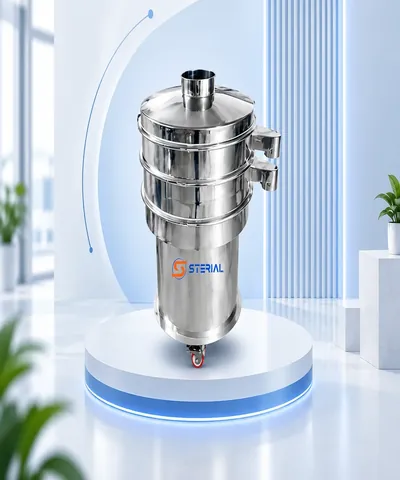
Pharmaceutical Vibro Sifter
cGMP-oriented design for sifting APIs, excipients and granules before blending and compression.
View details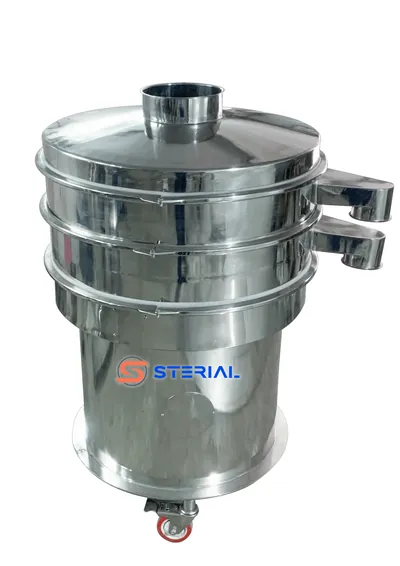
Food Grade Vibro Sifter
Stainless steel sifter for flour, spices, sugar, starch and other dry food ingredients.
View detailsStainless Steel Vibro Sifter
SS 316 contact parts and screens for corrosion resistance and easy cleaning.
View detailsIndustries: Pharmaceutical Industry · Food Processing Industry · Chemical Industry · Cosmetics Industry
Frequently Asked Questions
What is the capacity of a vibro sifter machine?
Indicative capacity ranges from 25–100 kg/hour for the 12" model to 200–1500 kg/hour for the 72" model. Actual output depends on bulk density, particle size, moisture and mesh.
What motor ratings are used?
From 0.25 HP on the 12" model to 3 HP on the 72" model, as listed in the specification table.
Which mesh sizes can be fitted?
Screens from 4 to 300 mesh. One machine can use different screens for different products.
Is the vibro sifter machine portable?
Yes. The standard design is compact and mounted on castors so it can be moved for cleaning or between rooms.
